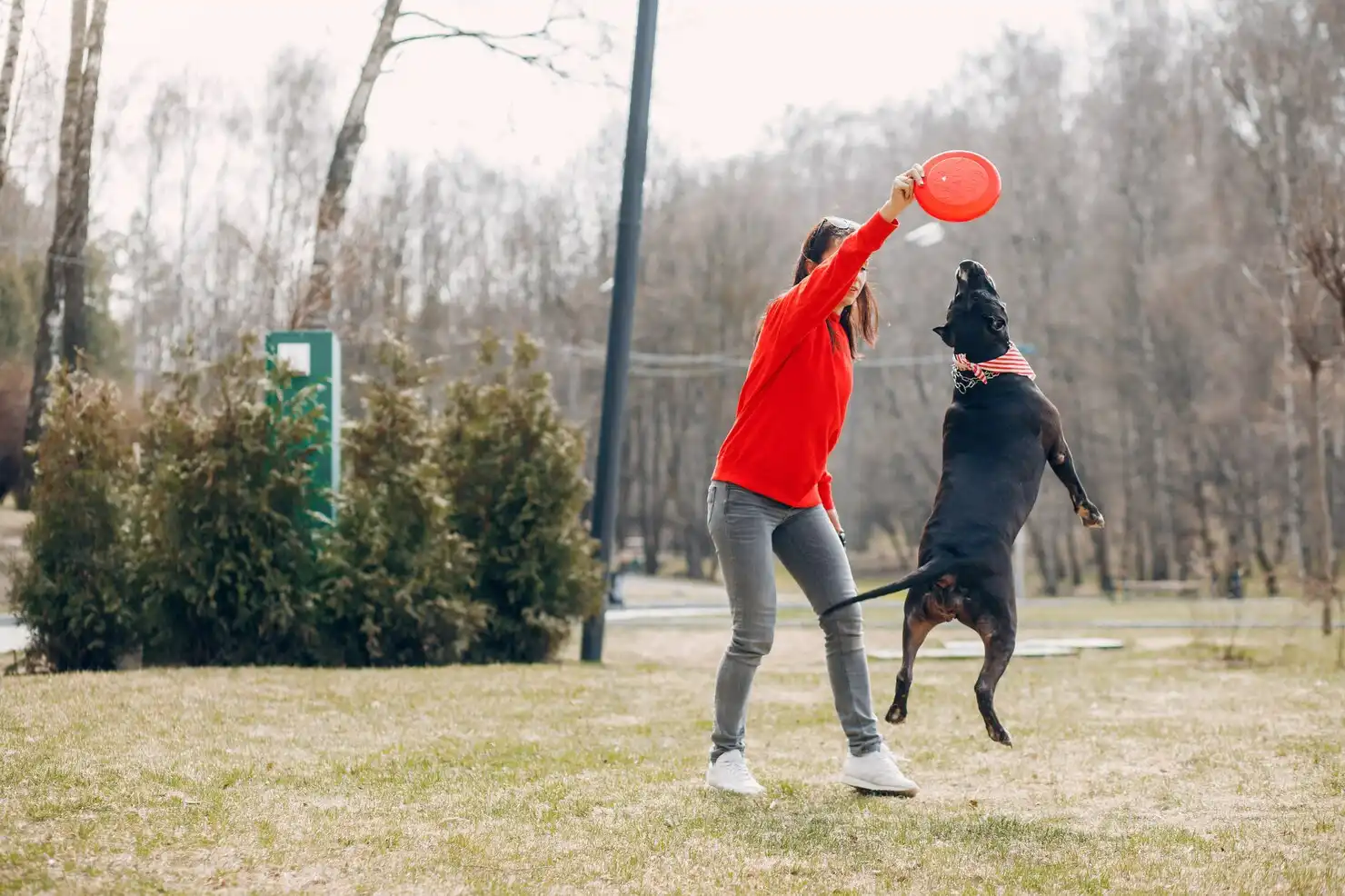
Freestyle Flying Disc Dog Training Guide
Freestyle flying disc dog sport is one of the most exciting and rewarding canine athletic activities you can pursue with your pet. It combines precise disc throwing, agile dog movement, and creative choreography into a dazzling performance.
Whether you are a complete beginner or an intermediate handler looking to level up, this comprehensive freestyle disc dog training guide covers everything — from choosing the right disc to perfecting advanced vault tricks and competition-ready routines.
Dog disc freestyle is not just sport. It is a deep bond-building activity that improves your dog’s physical fitness, mental stimulation, and obedience skills simultaneously. Let us dive in.
What Is Freestyle Flying Disc Dog Sport?
Freestyle flying disc dog sport — also called disc dog freestyle or canine disc sport — is a competitive and recreational activity where a handler and dog perform a choreographed routine set to music using flying discs.
Unlike simple fetch games, disc freestyle involves multiple discs, complex catching angles, aerial tricks, vaults off the handler’s body, and seamless transitions between moves. Judges score teams on athleticism, creativity, degree of difficulty, and execution.
Origins and Evolution of Canine Disc Sport
The sport traces its roots to 1974 when Alex Stein vaulted onto the field at a Dodgers game with his Whippet, Ashley Whippet, and performed an eight-minute impromptu disc routine that was broadcast live on national television. That moment ignited public fascination.
Over the decades, organized competitions emerged through organizations such as Skyhoundz, UpDog Challenge, and the International Disc Dog Handlers Association (IDDHA). Today, disc dog events run worldwide and attract thousands of teams annually.
Freestyle vs. Distance/Accuracy: Key Differences
Distance and accuracy (D/A) competitions measure how far a dog catches a single throw and how precisely it lands in marked zones. Freestyle, by contrast, is a timed choreographic routine — typically 60 to 90 seconds — judged on multiple criteria beyond raw distance.
Freestyle rewards creativity, athleticism, and the visible partnership between handler and dog. Many competitors participate in both formats, but freestyle is widely considered the more artistic and technically demanding discipline in disc dog sport.
Choosing the Right Equipment for Disc Dog Training
Equipment selection profoundly impacts training success, dog safety, and disc flight performance. The two biggest decisions are disc type and disc diameter, but handler footwear and apparel matter too.
Best Flying Discs for Dog Training
Not all flying discs are equal. Standard hard-plastic recreational discs can injure a dog’s mouth, teeth, and gums during catches. Purpose-built dog discs are manufactured from softer, flexible polymer materials that are both durable and mouth-safe.
Top brands trusted by professional disc dog competitors include Hyperflite, Hero Disc USA, Eurodisc, and Jawz. Hyperflite discs in particular are renowned for their consistent flight path, wind resistance, and long lifespan — critical for outdoor freestyle training in variable conditions.
For beginners, start with a standard 235-gram, 10.75-inch soft-polymer disc. It is large enough to be easy to catch and light enough for your dog’s developing jump mechanics.
Disc Diameter and Weight Guide
Disc diameter affects both throw distance and a dog’s ability to catch cleanly. Smaller discs (8.75 inches) favor fast, agile dogs and tight indoor spaces. Larger discs (10.75–12 inches) suit medium-to-large breeds and longer-distance throws in open fields.
Weight matters for flight stability. Lighter discs (130–165 grams) are easier to float on a slow hyzer angle, ideal for learning. Heavier competition-grade discs (235–285 grams) hold their flight path better in wind but demand more precise throwing mechanics.
Protective Gear and Training Accessories
A quality throwing glove reduces hand fatigue and improves grip during extended training sessions. Knee braces or padded shorts benefit handlers who practice frequent body vault setups. For your dog, trimmed nails prevent slipping during landings, and a well-fitted harness aids warm-up jogs before intense disc sessions.
Keep a cooler with fresh water and a portable shade tent at outdoor sessions. Canine overheating is a real risk in warm climates, and disc dog training is highly aerobic activity for your dog.
Is Your Dog Ready? Breeds, Age, and Fitness Considerations
Almost any healthy, medium-to-high-energy dog can learn disc sport basics. However, certain physical and developmental factors determine how quickly your dog progresses and what safety precautions to observe.
Best Dog Breeds for Disc Freestyle
Border Collies dominate competitive disc dog sport because of their extraordinary drive, agility, and trainability. Australian Shepherds, Belgian Malinois, Kelpies, and mixed-breed dogs with herding or working lineage also excel.
That said, Labrador Retrievers, Golden Retrievers, Vizslas, and even Staffordshire Bull Terriers have competed successfully at national level. Drive, health, and handler commitment matter far more than breed pedigree alone in disc freestyle.
Age and Growth Plate Safety
Do not begin jump training or high-impact catching drills with puppies younger than 12 to 18 months. Growth plates — the soft cartilage zones near bone ends — are vulnerable to stress injuries in young dogs. Premature jumping can cause permanent joint damage.
For puppies under 12 months, focus on disc introduction, motivation building, tug play with the disc, and flat rollers. Save aerial disc catching for when your veterinarian confirms skeletal maturity, which varies by breed and body size.
Veterinary Pre-Check and Physical Conditioning
Before beginning structured disc dog training, schedule a veterinary examination that includes hip and elbow assessment. Dysplasia, luxating patellas, or cardiac conditions may limit safe participation. Your vet can also advise on joint supplements such as omega-3 fatty acids and glucosamine for high-impact sport dogs.
A pre-training conditioning program — including leash walks, swimming, and gentle tug games — builds the core strength and cardiovascular fitness needed to sustain intense freestyle routines without injury risk.
Foundation Skills: Where Every Disc Dog Journey Begins
No matter how talented your dog is, skipping foundation skills creates gaps that surface under competition pressure. Great disc dog teams invest heavily in the basics before advancing to aerial tricks and complex choreography.
Building Disc Drive and Toy Motivation
Disc drive is a dog’s intense desire to chase, catch, and interact with a flying disc. Not every dog is born with it, but it can be developed using structured play protocols. Start by using the disc as a tug toy rather than a throw object. Short, exciting tugging sessions teach the dog to associate the disc with reward and excitement.
Keep early sessions under five minutes. End every session while the dog is still energetic and wanting more. The phrase ‘leave them wanting more’ is a cornerstone of positive reinforcement-based disc dog training methodology.
Teaching the Disc Retrieve
A reliable retrieve is non-negotiable for disc freestyle. Without it, your routine halts every time your dog catches a disc. Begin retrieve training in a narrow corridor — a hallway works well — to limit escape routes. Toss a disc a short distance, let the dog pick it up, then back away rapidly. Dogs are naturally inclined to chase movement; retreating triggers the retrieve instinct.
Progress to open spaces gradually as the retrieve becomes reliable. Never chase your dog to retrieve the disc. Chasing teaches the dog that keeping the disc is the game. Patience and consistent positive reinforcement deliver durable results.
The Dead Disc Exchange Technique
Once your dog retrieves consistently, introduce the dead disc exchange. Carry two discs. When the dog returns with disc one, present disc two excitingly at chest height. The dog drops disc one to grab disc two — which you immediately toss again. This exchange pattern forms the backbone of multi-disc freestyle routines and maintains continuous flow.
Throw Mechanics: Backhand, Sidearm, and Roller
Mastering throw mechanics is as important as dog training. An inconsistent thrower produces inconsistent catches, which undermines confidence and impedes skill progression. Practice throwing alone for 15 minutes before each training session with your dog.
The backhand throw is the foundational release in disc dog sport. Grip the disc with four fingers inside the rim, thumb on top. Step toward your target, rotate your hips and shoulders, and release with a flat, level follow-through. Aim for chest-to-shoulder height on short throws.
The sidearm (forehand) throw suits right-angle approaches and rapid back-to-back multi-disc sequences. Place your middle and index finger along the inside rim, thumb on top, and whip the disc outward with wrist snap. The roller — a disc thrown along the ground — builds a dog’s drive and footwork without aerial risk, making it ideal for warm-up exercises.
Intermediate Training: Jumps, Vaults, and Combination Moves
Once your dog retrieves reliably, catches consistently at moderate distance, and demonstrates strong disc drive, you are ready to introduce intermediate-level elements. These moves form the visual heart of competitive freestyle routines.
Teaching the Over Jump
The over jump — where the dog leaps over the handler’s outstretched leg or crouched body to catch a disc — is one of the most common freestyle elements and a natural starting point for aerial work. Begin with the handler kneeling and the dog jumping over a stationary leg without a disc. Reward enthusiastically. Once the dog jumps confidently, introduce a disc tossed just beyond the jump apex.
Gradually raise the height as muscle strength and jump mechanics improve. Never advance height faster than the dog’s confidence grows. Forced height progression is a leading cause of disc dog injury and loss of confidence.
Chest Vault and Arm Vault Progressions
Vaults are aerial moves where the dog uses the handler’s body as a launch platform. The chest vault involves the dog sprinting toward the handler, planting its front paws on the handler’s chest or thigh, and launching upward to catch a disc. Begin by teaching a clean paw-touch to your chest with no disc — use a hand target signal to guide the behavior.
The arm vault is slightly more advanced. The handler extends a forearm or holds both arms parallel like a bar. The dog plants one or both paws on the arm and vaults forward into a catch. These moves require excellent communication between handler and dog, consistent disc placement, and progressive height introduction over weeks of practice.
Back Vault: The Signature Freestyle Move
The back vault is the most visually spectacular beginner-intermediate vault. The handler turns their back to the dog, braces with a slight forward lean, and the dog runs up, plants both hind feet on the handler’s lower back or hips, and launches skyward into a disc catch overhead. Safety tip: always use a stable stance and practice the foot-plant portion without a disc throw until the dog’s placement is consistent and controlled.
Combination Sequences and Flow Development
Great freestyle routines are built from combination sequences — two or more moves performed in rapid succession with minimal dead time between catches. A basic combo might be: roller to build position, backhand catch at distance, dog returns, dead disc exchange, over jump catch, back vault, and finish move. Practice the sequence in slow motion first, then gradually increase speed.
Flow — the seamless, almost musical connection between moves — separates good routines from championship routines. Record your practice sessions and review them critically. Identify where your dog slows down, loses engagement, or where your throws are inconsistent. Those moments are your training priorities.
Advanced Freestyle Techniques for Competitive Teams
Advanced disc dog freestyle pushes both handler athleticism and canine aerial ability to the limit. These techniques require months of progressive foundation work and should only be introduced when the handler is confident in reading their dog’s physical signals.
Multiple Disc Sequences
Elite freestyle teams operate with four to six discs in play simultaneously, creating a visual spectacle of near-continuous disc flight. Managing multiple discs requires disciplined disc staging (pre-positioning discs on your body — tucked in waistband, held in the throwing hand, under the throwing arm) and split-second timing.
Practice disc staging without your dog until you can launch, retrieve a new disc, and throw again in under two seconds. Speed and smoothness in multi-disc handling directly determine routine intensity and scoring potential.
Distance and Angle Variation in Freestyle Throws
Monotonous distance and angle make routines visually flat. Advanced handlers deliberately vary throw distance (five feet to 50+ feet), angle (flat, hyzer, anhyzer), and trajectory (line drive, lofted floater, overhead skip) to create dynamic visual contrast and challenge their dog’s athleticism across the entire playing field.
Practicing with purpose — designating specific training sessions to angle variation, others to distance control, and others to trajectory — accelerates technical improvement faster than undirected repetition.
Trick Catches and Off-Axis Aerial Moves
Trick catches add style points and crowd excitement. Common advanced catches include the behind-the-back catch (disc thrown backward over the handler’s shoulder), the between-the-legs catch, the upside-down catch (dog rolls midair), and the tipped disc recovery. These moves require precise disc placement and a dog with exceptional spatial awareness and body control developed through progressive agility and disc training.
Canine Conditioning for Advanced Disc Sport
Advanced aerial moves put significant load on a dog’s shoulder joints, spine, and hindquarters. A structured canine conditioning program — including balance board work, cavaletti poles, underwater treadmill sessions, and targeted core strengthening — dramatically reduces injury risk and improves aerial power and landing mechanics.
Work with a certified canine rehabilitation therapist or sports conditioning coach to build a season-appropriate conditioning calendar. Peak conditioning for major competitions, followed by deliberate off-season recovery, mirrors best practices from elite human athletics and extends your dog’s competitive career.
Choreographing Your Freestyle Disc Dog Routine
A well-choreographed routine tells a story and showcases the unique strengths of your specific dog-handler team. Choreography is not just about selecting moves — it is about pacing, music sync, spatial use of the field, and emotional arc.
Selecting and Editing Your Music
Music selection profoundly shapes the tone and energy of your routine. Choose a track with a clear, consistent beat between 120 and 160 BPM for active throwing sequences. Edit your track to exactly 60 or 90 seconds (depending on competition format) using free tools such as Audacity or GarageBand.
Map your planned move sequence to specific musical phrases. High-energy sequences should align with chorus peaks. Quiet disc rollers or position resets suit verse sections with lower intensity. Musical synchronization is a significant judging criterion in major disc dog organizations.
Field Zones and Spatial Choreography
Judges and audiences experience your routine from the edge of a designated field area, typically 50 by 50 feet. Plan your choreography to use all four quadrants of the field. Routines confined to one quadrant appear static and waste the spatial canvas available to you.
Begin and end your routine in the center of the field. This creates a symmetrical visual frame and ensures your final move — ideally your highest-difficulty element — is front-and-center for judges.
Scoring Criteria: What Judges Look For
Judges in major disc dog freestyle competitions evaluate routines on athleticism (difficulty and quality of jumps/vaults/catches), execution (precision of throws and catches), creativity (novel move selection and routine design), flow (seamless transitions), and showmanship (handler presence, costume, and audience engagement). Understanding scoring criteria allows you to deliberately engineer high-scoring elements into your routine architecture.
Competition Preparation and What to Expect at Your First Event
Competing in your first disc dog event is an exciting milestone. Preparation goes beyond perfecting your routine — environmental desensitization, logistical planning, and understanding event structure all contribute to a positive debut experience.
Pre-Competition Training Strategy
In the six weeks before a competition, gradually increase routine repetition to three to five full run-throughs per week. Simulate competition conditions by practicing in unfamiliar locations, in front of small audiences, and with the distraction of other dogs nearby. Dogs that only train in familiar home environments often underperform in competition settings due to environmental novelty.
Two weeks before the event, reduce high-impact training intensity by 30 percent. This pre-competition taper preserves energy reserves and reduces soft tissue injury risk during peak demand.
Event Day Logistics and Dog Care
Arrive at least two hours before your scheduled run time. Allow your dog to acclimate to the event environment — walk the grounds, let the dog sniff and observe, and do light warm-up exercises. Feed your dog a light meal three to four hours before competing to avoid exercise-related gastrointestinal upset.
Bring a portable crate, shade tent, fresh water, cooling mat, first aid kit, and multiple disc options (different weights and diameters) in case conditions change. Wind speed and field surface affect disc flight significantly at outdoor events.
Managing Competition Nerves — Yours and Your Dog’s
Handler anxiety is real and transmits directly to dogs through leash tension, body language, and vocal tone changes. Develop a consistent pre-routine ritual: deep breathing, a specific warm-up sequence, and a calm verbal cue that signals to your dog that exciting work is about to begin. Pre-competition mental rehearsal — visualizing a smooth, joyful routine — is a proven performance psychology technique adopted by elite handlers worldwide.
Health, Safety, and Injury Prevention in Disc Dog Training
Disc dog sport is physically demanding. Proactive health management is not optional — it is the foundation that sustains a long, successful career in the sport for both you and your dog.
Common Injuries and How to Prevent Them
Shoulder strains, cruciate ligament injuries, and toe injuries from hard landings are among the most frequently reported disc dog injuries. Prevention requires progressive conditioning, appropriate surface choices (avoid concrete and very hard-packed dirt), consistent warm-up and cool-down routines, and attention to early lameness signals.
If your dog shows any reluctance to jump, licks a joint, or holds a leg slightly elevated after training, rest for 48 hours and consult your veterinarian before resuming disc work. Pushing through early warning signs converts minor issues into career-threatening injuries.
Warm-Up and Cool-Down Protocols
A proper warm-up for disc dog training should last 10 minutes and include a brisk leash walk, gentle range-of-motion movements (manually flexing and extending limbs through comfortable range), and two to three short, low-intensity disc rollers to elevate the heart rate progressively.
Cool-down after training is equally critical. Five minutes of slow walking followed by gentle massage of the major working muscle groups — shoulders, haunches, and spine — accelerates recovery and reduces delayed-onset muscle soreness in athletic dogs.
Nutrition and Hydration for Athletic Dogs
Sport dogs competing regularly have caloric needs 20 to 40 percent above sedentary maintenance levels. Choose a high-protein, moderate-fat performance dog food formula appropriate for your dog’s size and activity level. Electrolyte supplementation is beneficial during multi-day competition weekends in warm climates. Fresh water should always be available before, during, and after training, and dogs should be encouraged to drink at every break opportunity.
Training Tools, Apps, and Community Resources
Modern disc dog training benefits from a rich ecosystem of online resources, video analysis tools, coaching platforms, and community groups that accelerate learning far beyond what isolated practice achieves.
Video Analysis for Disc Dog Improvement
Recording and reviewing training video is the single most effective self-coaching tool available to handlers at any skill level. Set up a tripod or ask a training partner to film each session from a consistent angle. Review footage specifically looking at disc placement relative to the dog’s jump apex, handler footwork during vault setups, and the dog’s landing mechanics.
Slow-motion playback (available on most smartphones) reveals details invisible at real-time speed — including whether your disc is arriving a fraction of a second early or late and whether your dog’s spine is straight on landings. These micro-adjustments dramatically improve catch consistency over time.
Online Communities and Coaching Platforms
Facebook groups dedicated to disc dog sport — including Disc Dog Freestyle Worldwide and Skyhoundz Community — offer technique critique, event listings, and mentorship from experienced competitors. YouTube channels by professional disc dog athletes such as Josh Grenell and Chuck Middleton provide free instructional content of exceptional quality.
For structured learning, platforms like Fenzi Dog Sports Academy offer disc-specific online courses with video submission and personalized instructor feedback — an invaluable resource for handlers without access to local disc dog clubs.
Local Clubs and Training Groups
Training with others accelerates skill development through peer accountability, friendly competition, shared equipment, and the essential socialization that prepares dogs for multi-dog competition environments. Use the Skyhoundz club finder or IDDHA club directory to locate a club near you. Many clubs welcome beginners and provide loaner discs and introductory clinics to lower the barrier to entry for newcomers to disc dog sport.
Frequently Asked Questions About Freestyle Disc Dog Training
What Age Can a Dog Start Disc Training?
Dogs can begin introductory disc motivation and retrieval training as young as eight to ten weeks using flat rollers and short tosses. However, jumping and aerial catching should wait until skeletal maturity — typically 12 to 18 months depending on breed size. Always consult your veterinarian before beginning jump training.
How Long Does It Take to Train a Disc Dog?
A motivated dog with a dedicated handler can learn basic catches and a simple two-minute routine within three to six months of consistent twice-weekly training. Competitive-level freestyle — featuring vaults, multi-disc sequences, and full choreography — typically requires 12 to 24 months of progressive training.
What Is the Best Disc for Beginners?
For most beginner teams, a Hyperflite Jawz or Hero Disc USA standard 235-gram disc in the 10.75-inch diameter is the ideal starting point. These discs are soft enough to be mouth-safe, durable enough for regular training, and consistent enough in flight for learning accurate throw mechanics.
Can Small Dogs Do Disc Freestyle?
Absolutely. Small and toy-breed dogs compete in disc freestyle at many events, with disc diameter, throw distance, and vault height scaled appropriately. Breeds like Jack Russell Terriers, Miniature Australian Shepherds, and Shetland Sheepdogs have notable competitive histories in the sport.
Conclusion: Your Freestyle Flying Disc Dog Journey Starts Today
Freestyle flying disc dog training is a sport that rewards patience, consistency, and genuine partnership between handler and dog. From the very first roller toss to the adrenaline of a competition finale vault, every step of the journey deepens the bond between you and your dog.
Start with the foundations: build disc drive, develop a reliable retrieve, master your throw mechanics. Progress deliberately through jumps and vaults. Choreograph with intention. Compete with joy.
Your dog does not know what a score sheet says. What your dog knows is whether training is exciting, rewarding, and safe. Build those three conditions every session, and the sport will give both of you far more than ribbons and trophies.
Explore more training tips, product reviews, and pet sport guides right here on PetEliteCare.com — your trusted resource for everything your pet deserves.